
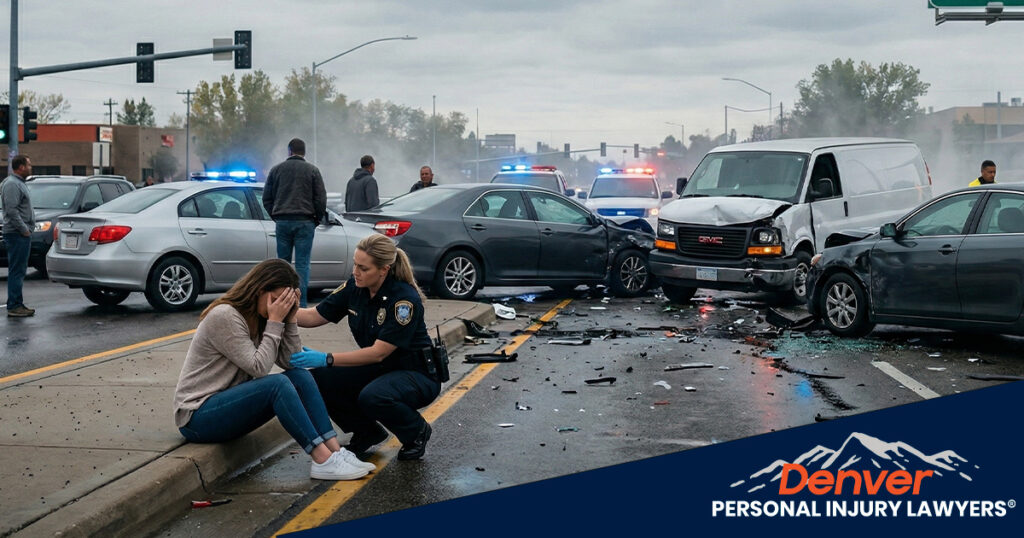
Recent headlines underscore this pattern. In late 2025, a serious multi-vehicle crash in Aurora along a busy arterial corridor temporarily shut down lanes during peak traffic hours, sending several people to the hospital and forcing a prolonged investigation. Incidents like that are not isolated events. They reflect recurring crash dynamics that appear again and again across the city’s highest-traffic intersections.
Table of Contents
ToggleAurora Car Accident Hotspots You Should Know Before You Drive
Hotspots are real but constantly shift with time of day, construction, school traffic, special events, and Aurora weather like snow, ice, and glare. These areas share common risks such as heavy turning traffic, tight merges, pedestrian crossings, red light running, and last-minute lane changes. When speed changes combine with distraction, the likelihood of an Aurora car accident increases significantly.
Hotspot #1: East Colfax Avenue in Aurora, CO
East Colfax Avenue is a high-volume corridor with frequent stops, closely spaced intersections, heavy driveway traffic, and buses constantly pulling in and out. Traffic flow changes quickly, leading to sudden braking and delayed reactions that often result in a rear-end Aurora car accident.
Left turns add another layer of risk. Even with a green light, oncoming vehicles and pedestrians complicate the maneuver, making side-impact crashes common. Near Colfax Avenue and Havana Street, stacked traffic increases impatience, and drivers may gamble on short gaps. When turning drivers misjudge oncoming speed, angle and T-bone collisions frequently follow.
Hotspot #2: Near South Parker Road and Iliff Avenue in Aurora
South Parker Road and Iliff Avenue can feel deceptively fast, but traffic patterns shift quickly near turning lanes and busy commercial entrances. Rapid speed changes combined with heavy turning traffic create frequent conflict points.
Common Aurora car accident patterns here include rear-end collisions in stop-and-go backups, left-turn errors late in the signal cycle, and angle crashes during light changes when one driver anticipates yellow and another tries to clear the intersection. Leave more following distance than you think you need, and move into the correct lane early to avoid a last-second lane change.
Hotspot #3: Around Havana Street and Alameda Avenue in Aurora, Colorado
Havana Street and Alameda Avenue often feel hectic, particularly during peak shopping hours. Constant in-and-out retail traffic, drivers weaving toward turn lanes, and queues spilling into through lanes create tight margins for error. In these conditions, even a small mistake can trigger a multi-vehicle Aurora car accident.
Common crashes include merging collisions when drivers force short gaps, sideswipes from hurried lane changes, and chain-reaction pileups when one driver brakes hard for a turning vehicle and others follow too closely. Slow down sooner than usual, even on a green light, and watch the front wheels of nearby cars. If they start to turn, you can react earlier.
Hotspot #4: Near Chambers Road and Mississippi Avenue
Chambers Road and Mississippi Avenue carry heavy commuter traffic, leading to long lines, impatient turns, and higher distraction risks. As congestion builds, some drivers glance at phones or navigation and miss brake lights, increasing the chance of a crash.
Rear-end Aurora car accident collisions are common in backups, and T-bone crashes occur when a driver misjudges a left-turn gap or pushes through a yellow light. Approach the intersection expecting an unexpected turn, and when the light turns green, take a moment to scan left and right before proceeding. That brief pause can prevent a serious impact.
Aurora Car Accident Hotspot #5: At Peoria Street and Buckley Road
Peoria Street and Buckley Road blend neighborhood traffic with frequent turning movements. In many stretches, school-related traffic and pedestrians add another layer of unpredictability. Because speeds shift quickly, drivers often misread how traffic will move next.
Common Aurora car accident patterns here include left-turn crashes, side-impact collisions, and rear-end crashes when traffic slows with little warning. Larger vehicles can block visibility, making turns even riskier. If you are behind a tall SUV or truck, increase your following distance so you can spot signal changes and cross traffic sooner.
Aurora Car Accident Hotspot #6: At The I-225 Interchange and The I-225 Corridor
The I-225 interchange and surrounding corridor create constant merging pressure. Drivers accelerate to enter, brake when traffic compresses, and weave across lanes to reach exits. When speeds fluctuate like this, chain-reaction crashes can unfold quickly.
Common Aurora car accident patterns in this area include merging collisions, speed-related impacts, and multi-vehicle rear-end crashes during sudden slowdowns. Even a minor fender bender can become dangerous when vehicles stop in active lanes. Stay out of blind spots, maintain a steady speed, and leave extra space. If you miss your exit, take the next one. It may be inconvenient, but it is safer.
How You Can Lower Risks on Busy Aurora Roads
You cannot control other drivers. However, you can reduce your risk of an Aurora car accident with a simple routine.
- First, slow your decision making. If traffic feels chaotic, then commit to earlier lane changes and earlier braking.
- Next, protect your following distance. Even an extra car length can give you time to react.
- Then, treat intersections like active danger zones. Scan for late left turns and red light runners before you enter.
- Also, avoid the “wave through” trap. If someone waves you to turn, you still must confirm all lanes are clear.
- Meanwhile, watch for pedestrians and cyclists. In retail areas, they can appear between stopped cars.
- Finally, adjust for weather. When roads are wet or icy, braking distances increase. Therefore, slow down sooner.
These steps are small. Still, when you repeat them every day, they reduce the chances that your next trip ends in an Aurora car accident.
What To Do Right After an Aurora Accident
After an Aurora car accident, you may feel shaken. Therefore, you need a clear order of operations.
- Get to safety first. Check for injuries and move out of traffic if possible. Relocate vehicles to a shoulder or nearby lot if it is safe.
- Call 911 when needed. Call if anyone is injured, traffic is blocked, a DUI is suspected, or the scene feels unsafe. A police report can help if facts are later disputed.
- Document the scene. Take photos of vehicle positions, damage, plates, skid marks, debris, traffic signals, and the overall roadway.
- Get witness information. Ask for names and phone numbers, especially if someone saw the light change or a turning movement.
- Exchange required information. Share contact and insurance details, but do not argue fault. Keep it factual.
- Get medical care. Even minor symptoms can appear later, so get evaluated and follow medical advice.
- Notify your insurer promptly. Report basic facts, but be cautious with recorded statements if injuries are still developing.
Finally, contact an Aurora car accident lawyer early. Before giving detailed statements or accepting any settlement, consider speaking with an attorney. An Aurora car accident claim can involve disputed liability, injury valuation issues, and insurance pressure. Early legal guidance helps protect evidence, clarify deadlines, and prevent costly mistakes.
Your Legal Options After An Aurora, CO Car Crash
Not every crash requires a claim. However, after an Aurora car accident involving injuries, missed work, disputed fault, or significant damage, you should speak with a lawyer before accepting any settlement. Insurance companies move quickly, and early legal guidance helps protect your rights.
Damages You Can Seek in Colorado
After an Aurora car accident, the damages you may be able to seek typically fall into these categories:
Economic damages
- Medical bills, including ER care, imaging, surgery, and physical therapy
- Future medical care, if you need ongoing treatment
- Lost income from missed work
- Reduced earning capacity, if you cannot return to the same work
- Property damage, including repair or total loss value and related costs
Non-economic damages
- Pain and suffering
- Emotional distress
- Loss of enjoyment of life
- Physical impairment
- Disfigurement
Wrongful death damages
- If a loved one dies in an Aurora car accident, surviving family members may be able to pursue wrongful death damages.
You typically have only one opportunity to resolve your Colorado car accident claim, which makes experienced legal guidance critical. An insurance company’s goal is to limit payouts, not to fully account for how an Aurora car accident has affected your life. An Aurora car accident attorney can evaluate the true value of your economic and non-economic damages, gather the necessary evidence, handle negotiations, and protect you from accepting a premature settlement. Strong representation significantly reduces the risk of leaving compensation on the table.
FAQs (Frequently Asked Questions)
What are the main factors contributing to car accidents in Aurora hotspots?
Car accidents in Aurora hotspots often result from high traffic volumes, quick signal cycles, competing turning movements, congestion causing sudden braking, frequent driveways and bus stops, speed differentials, and driver distractions.
Which roads in Aurora are known as major car accident hotspots?
Major Aurora car accident hotspots include East Colfax Avenue, South Parker Road and Iliff Avenue, Havana Street and Alameda Avenue, Chambers Road and Mississippi Avenue, Peoria Street and Buckley Road, and the I-225 interchange and corridor.
What should drivers do after being involved in a car accident?
After an Aurora car accident, prioritize safety by moving to a safe location if possible, exchange required information, document the scene with photos, seek medical care if needed, report the crash as required by Colorado law, and consider your legal options.
What compensation can I recover after a Colorado car accident?
You may recover economic damages such as medical bills, lost wages, and property damage, as well as non-economic damages like pain and suffering, emotional distress, impairment, and loss of enjoyment of life. The value depends on the severity of your injuries and how they affect your work and daily life.
Get Clear Answers and Strong Representation After an Aurora Crash
After an Aurora car accident, you should not have to guess about your next steps, critical deadlines, or confusing insurance paperwork. You deserve clear answers about your options, guidance on preserving evidence, and strong advocacy when insurance companies start applying pressure.
At Denver Personal Injury Lawyers®, we understand how overwhelming the days and weeks after a crash can feel. Whether your collision happened near I-225, Colfax Avenue, or another Aurora car accident hotspot, our legal team can step in quickly to protect your claim, calculate the full value of your damages, and deal directly with insurers on your behalf.
You do not have to handle this alone. Contact us today for a free consultation and learn how we can help you move forward with confidence.