
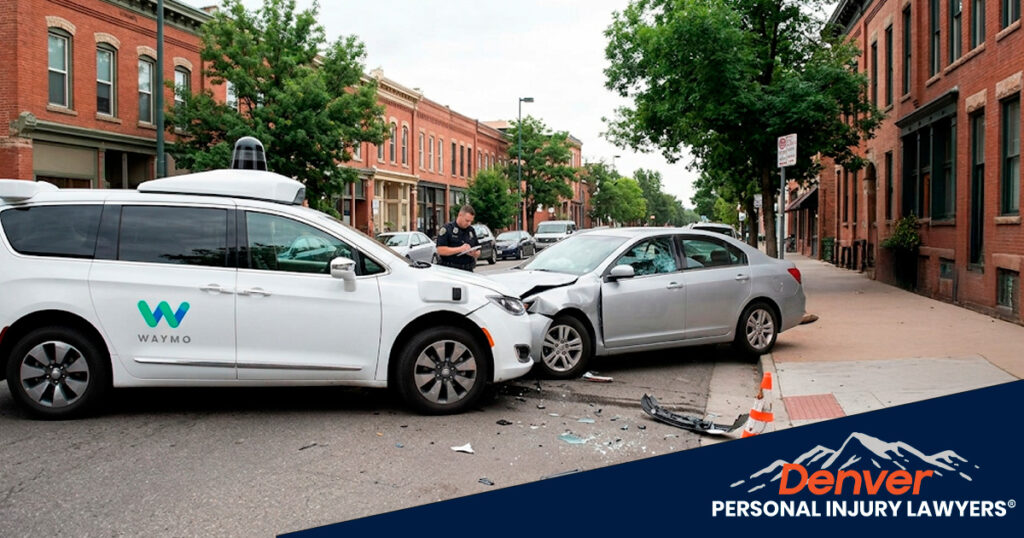
You may have already seen Waymo vehicles on Denver streets, but the latest news marks a major shift. Since September 2025, Waymo has been testing in Denver with employees behind the wheel. Now in July 2026, the company says fully autonomous rides could begin in a matter of weeks. That makes a Waymo car accident in Denver a real concern for drivers, cyclists, pedestrians, and passengers.
At first, driverless rides are expected to be limited to employees and certain neighborhoods, including RiNo, Baker, and Cherry Creek. Public rides are expected later, though Waymo has not announced an exact date.
A Waymo crash is different from a standard car accident because there may be no human driver to blame. Instead, the claim may turn on autonomous driving data, commercial insurance, software decisions, sensor performance, and whether another driver or road condition contributed to the crash. Knowing what to do early can help protect your health, evidence, and injury claim.
Table of Contents
ToggleHow A Waymo Car Works On Denver Streets
A Waymo vehicle does not “see” like a human. Instead, it builds a digital model of the world around it.
First, it uses 360-degree cameras. These capture continuous video of nearby traffic, people, and signals. Next, it uses LiDAR. LiDAR sends laser pulses, then measures reflections. As a result, it builds a real-time 3D map of objects around the car. It also uses radar, which tracks speed and distance well, even in poor weather.
Then the software combines that sensor input with detailed maps. After that, the system predicts what other road users might do. For example, it may predict a pedestrian stepping off the curb. Or it may predict a car merging without signaling.
Finally, the system records AI decision logs. These logs can show what the system detected and how it responded. That includes braking, acceleration, steering, and object classification. In a Waymo car accident in Denver, these logs can become critical evidence. However, Waymo controls that data.
Waymo Car Accident In Denver: What These Crashes Can Look Like
Most crashes will look familiar. Still, the causes can be different. Therefore, you should know the patterns attorneys and investigators watch for.
Here are common crash scenarios linked to autonomous driving behavior and city traffic:
- Rear-end crashes after sudden braking
- Sudden stops near crosswalks or turn lanes
- Left turns or right turns at complex intersections
- Merging issues during lane changes
- Contact with curbs, cones, or road barriers
Cyclists and pedestrians face special risk. A person may step out near an event. A cyclist may filter forward at a red light. A rideshare passenger may open a door into a bike lane. So, even if the Waymo car follows the rules, chaos around it can still trigger a collision.
What To Do Immediately After A Waymo Car Accident In Denver
After a Waymo car accident in Denver, your priorities are safety, evidence, and protecting your claim. Take these steps as soon as possible:
- Get to safety and check for injuries: Move out of traffic if possible. Check for pain, dizziness, weakness, or confusion.
- Call 911: Ask for police and medical help. A police report and prompt treatment can support your claim.
- Document the scene: Take photos and videos of damage, vehicle positions, signals, lane markings, debris, and Waymo branding.
- Do not guess about fault: Stay polite, but stick to facts. Do not apologize, argue, or speculate.
- Collect witness information: Get names, phone numbers, emails, and brief statements if possible.
- Write down vehicle details: Note the license plate, vehicle model, Waymo markings, time, and exact location.
- Report the crash carefully: Give your insurer basic facts only. Do not downplay injuries or accept blame.
- Contact a Denver Waymo car accident lawyer early: A lawyer can preserve technical data, investigate the crash, deal with insurers, and protect your claim.
Waymo Car Accident In Denver Evidence: What To Preserve And Why
A standard crash may depend on a police report and witness accounts. A Waymo car accident in Denver may depend on data.
Waymo vehicles may record camera footage, LiDAR, radar, system status, and decision logs. This data can be critical, but it is controlled by Waymo and may require preservation demands, subpoenas, or litigation to obtain.
In the meantime, preserve what you can:
- Photos and videos from your phone
- Dashcam footage
- Nearby business or home security video
- Witness names and contact information
- Police report number and responding agency
- Medical records, discharge papers, and bills
- Receipts for medications, rides, and other costs
Act quickly. A Denver Waymo car accident lawyer can help preserve key evidence before data is lost or overwritten. In these claims, speed can make the difference between guessing what happened and proving it.
Who Can Be Liable After A Waymo Car Accident In Denver
Liability after a Waymo car accident in Denver may involve more than one party. The key question is why the crash happened and who contributed to it.
Responsible parties may include:
- Waymo or related entities: If the autonomous system caused or contributed to the crash.
- Another driver: If another motorist helped cause the collision.
- A manufacturer or supplier: If a sensor, part, software issue, or hardware failure played a role.
- A safety operator or test driver: If the vehicle was in supervised testing and human error contributed.
- A city, contractor, or road crew: If unsafe construction, poor signage, malfunctioning signals, or dangerous road conditions contributed.
Some claims may involve traditional negligence. Others may involve product liability if a defect in the vehicle, software, sensors, or related systems caused harm.
Because these claims can involve multiple parties and technical evidence, speak with a Denver Waymo car accident lawyer as soon as possible. An Denver personal injury attorney can identify who may be responsible, preserve key evidence, and protect your claim from the start.
Who Pays If A Waymo Car Hits You In Denver?
Once liability is investigated, the next question is which insurance coverage applies.
Waymo’s insurance coverage: If the autonomous vehicle caused the crash, Waymo’s commercial insurance should be one of the first places to look for compensation. These claims may involve higher commercial policy limits than Colorado’s minimum auto coverage of $25,000 per person, $50,000 per accident, and $15,000 for property damage. However, the available limits may not be obvious right away, so your Denver Waymo car accident lawyer may need to request policy information and preserve key crash data.
Other coverage may also matter: Your own auto insurance, health insurance, MedPay coverage, uninsured/underinsured motorist coverage, or another driver’s liability policy could also apply. That is why every possible source of compensation should be identified early.
Because multiple insurers may be involved, these claims can move slowly while adjusters review liability, vehicle data, statements, and crash reports. Keep every bill, repair estimate, receipt, explanation of benefits, and record of missed work. Be careful with recorded statements and early releases. Before giving detailed statements or signing anything, consider speaking with a Denver Waymo car accident lawyer.
What Compensation May Be Available After A Waymo Car Accident In Denver?
Compensation after a Waymo car accident in Denver may depend on the severity of your injuries, the available insurance coverage, and how clearly the evidence shows what happened. If the autonomous vehicle, another driver, or another responsible party caused your injuries, you may be able to pursue compensation for both financial losses and the personal impact of the crash.
Potential compensation may include:
- Medical bills
- Future medical treatment
- Lost wages
- Reduced earning ability
- Pain and suffering
- Property damage
- Out-of-pocket costs
- Transportation expenses
- Long-term physical limitations
Deadlines also matter. In Colorado, car accident claims generally have a three-year filing deadline. However, some claims, including claims involving government entities, may have much shorter notice requirements. Because evidence and deadlines can move quickly, it is important to speak with a Denver Waymo car accident lawyer as soon as possible.
FAQs (Frequently Asked Questions)
What is Waymo and why is it expanding to Denver?
Waymo is an autonomous vehicle company operating driverless ride services using Level 4 autonomy, which means the system drives itself within defined areas and conditions. Denver is one of its expansion cities, with testing since September 2025 and full public service expected in July 2026.
What losses can be included in a Waymo accident claim?
A claim may include medical bills, future treatment, lost wages, reduced earning ability, pain and suffering, property damage, and out-of-pocket costs. Colorado car accident claims generally have a three-year filing deadline, but shorter notice rules may apply in some cases.
What are common types of Waymo car accidents that could occur in Denver?
Common crash scenarios include rear-end collisions after sudden braking, sudden stops near crosswalks or turn lanes, challenges with left or right turns at complex intersections, merging issues during lane changes, and contact with curbs or road barriers. Denver’s unique traffic conditions like dense pedestrian flow and construction zones can contribute to these incidents.
What should I do immediately after being involved in a Waymo car accident in Denver?
First, move to safety if possible and check for injuries. Call 911, get medical help, and document the scene with photos or videos of vehicle positions, damage, signals, lane markings, and Waymo branding.
Can I access the data recorded by a Waymo vehicle after an accident?
Waymo controls access to AI decision logs that record sensor detections and system responses during driving. These data logs can be critical evidence in investigating a Waymo car accident in Denver but typically require formal requests through legal channels or insurance claims processes.
Injured In A Waymo Car Accident In Denver? Protect Your Claim Early
A Waymo car accident in Denver is not a typical injury claim. The evidence is more technical, liability may involve multiple parties, and the most important vehicle data may be controlled by a powerful company. That is why quick action matters. An experienced legal team can send evidence preservation demands, look for third-party video, investigate what happened, and protect you from mistakes that insurers may use against you later.
At Denver Personal Injury Lawyers®, we help injured people get answers, build strong claims, and pursue the compensation they deserve. From medical documentation and insurance negotiations, our team is ready to guide you through every step.
If you were hurt in a Waymo car accident in Denver, contact us today for a free consultation.
