
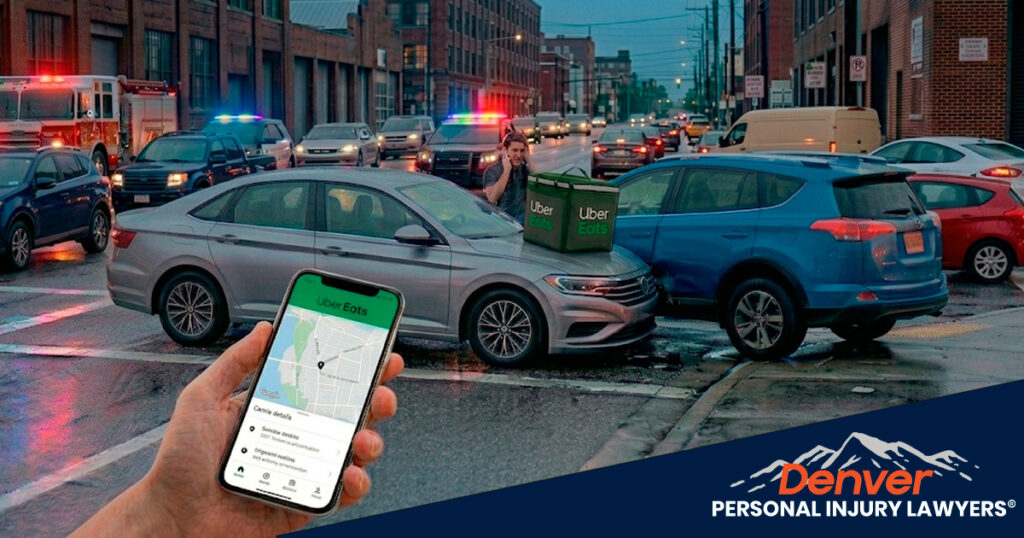
An Uber Eats driver accident in Denver can happen when delivery drivers rush to complete orders, check GPS directions in traffic, or try to handle multiple deliveries during busy hours. Uber Eats has become one of the most popular food delivery apps in Denver Metro, especially as more residents rely on delivery services for lunch, dinner, and late-night orders. That growing demand means more delivery drivers are spending long hours on Denver roads under pressure to complete orders quickly. As a result, the risk of distracted driving and serious crashes involving other motorists, pedestrians, and cyclists can increase.
Unlike a typical car accident, an Uber Eats driver accident in Denver can become complicated very quickly. Insurance coverage may depend on whether the driver was actively completing a delivery, waiting for an order, or offline at the time of the crash. As a result, injured victims are often left dealing with multiple insurance companies, coverage disputes, and aggressive settlement tactics. This is why an Uber Eats delivery accident lawyer is so important.
Table of Contents
ToggleWhy An Uber Eats Driver Accident In Denver Metro Gets Complicated Fast
Right after a crash, most people expect a simple claim. You exchange insurance. Then the at-fault driver’s carrier pays. However, an Uber Eats driver accident in Denver often triggers a different process.
First, Uber Eats usually treats drivers as independent contractors. So, Uber Eats often argues it is not automatically responsible. Second, insurance can change by the minute. The policy may depend on whether the driver had the app off, was waiting, or was delivering. As a result, insurers can dispute coverage and delay payment.
Because of that, you should assume evidence will matter. Therefore, you must act early. If you wait, digital records can disappear. Also, stories change. So, you need facts, not guesses.
How Liability Works When The Uber Eats Driver Causes The Crash
Colorado fault rules still apply: the driver who caused the crash usually pays. So, if the Uber Eats driver was negligent, you can pursue a claim.
Common negligence looks ordinary, yet it causes real harm, such as:
- Speeding to finish a delivery
- Unsafe lane changes on I-25 or I-70
- Distracted driving while checking the app
- Rolling stops in neighborhoods
- Rushed parking and sudden stops at the curb
If you were hit, you may file a third-party claim against the driver’s liability insurance. That is often the starting point after an Uber Eats driver accident in Denver. Still, the insurer may ask whether the driver was delivering. If so, it may try to shift coverage elsewhere.
Uber Eats Driver Accident In Denver Insurance Periods And The Coverage Gap
Uber Eats coverage often depends on what the driver was doing in the app. For that reason, the timeline matters as much as the crash report.
Phase 0: App Off
If the app was off, the driver is usually “off duty.” Then the driver’s personal auto policy usually applies. However, you still must confirm the policy exists and was active.
Phase 1: App On, Waiting For An Order
Here is where disputes often begin after an Uber Eats driver accident in Denver. The app is on, yet no order is accepted. Coverage may be limited. Also, some claims get delayed while insurers argue about which policy applies.
This is the “coverage gap” risk. Even if some coverage exists, it may not match your losses. Therefore, you must document the driver’s status early.
Phase 2: Order Accepted, Driving To The Restaurant
Once the driver accepts an order, coverage may increase, depending on policy terms. Still, you should not assume the insurer will agree. Instead, you should gather proof of acceptance time and location.
Phase 3: Food In Car, Active Delivery
This is often the strongest phase for third-party liability coverage. Many delivery company policies provide high limits during active delivery. Even so, the insurer may still challenge whether the driver was truly in Phase 3. Therefore, proof remains critical.
Personal Auto Insurance Versus Commercial Insurance Coverage
Personal auto insurance is designed for personal driving, while commercial coverage applies to business activity. Because of that, many personal policies exclude delivery driving.
If the driver was working for Uber Eats during the crash, coverage may depend on the driver’s app status. When waiting for an order, Uber Eats may provide limited liability coverage of $50,000 per person, $100,000 per accident, and $25,000 for property damage. Once the driver accepts or completes a delivery, Uber Eats generally provides up to $1 million in third-party liability coverage.
As a result, an Uber Eats delivery driver accident in Denver can quickly turn into a complicated insurance dispute involving multiple policies and carriers.
Uninsured And Underinsured Motorist Coverage Can Matter
UM coverage can help if the at-fault driver has no insurance. UIM coverage can help if the at-fault limits are too low.
For example, your medical bills might reach $60,000. Yet the available liability limits might be $25,000. Then your UIM coverage may help close the gap, if you carry it. Therefore, your own policy can matter even when the other driver caused the crash.
How To Prove The Driver Was On A Delivery At The Time Of The Crash
This is where many people lose leverage. They rely on memory. Or they rely on casual statements. However, app status is usually proven with digital records. So you must act quickly.
Useful evidence can include:
- App logs showing on duty times
- Delivery timestamps for order acceptance and drop-off
- GPS and route data
- Phone records, including data activity
- Photos of the vehicle, plates, and any delivery bags
- Witness statements about the driver’s behavior at the scene
Screenshots can help. For instance, a driver may show an active order screen. Yet screenshots are not enough by themselves. They can be incomplete. Also, they can be disputed. Therefore, you want preserved records from the right sources.
What Not To Say To Insurance After A Delivery Driver Crash
Insurance calls can feel friendly. However, adjusters work for the insurer. Also, many calls are recorded. Therefore, keep your statements short and factual.
Avoid these common mistakes:
- Do not guess about speed, distance, or timing.
- Do not say you “did not see them” unless you are sure.
- Do not accept blame to be polite.
- Do not say you are fine if you feel uncertain.
- Do not minimize pain because you feel pressured.
Pain can appear later. Whiplash and soft tissue injuries often worsen in the next 24 to 72 hours. So, if you do not know yet, say that.
Also, quick low offers happen for a reason. Insurers want closure before you finish treatment. Therefore, do not sign releases or accept money until you understand your full damages.
Mistakes That Can Hurt Your Uber Eats Accident Claim
After an Uber Eats delivery driver accident in Denver, small mistakes can seriously affect your claim. Insurance companies may look for reasons to reduce payouts, dispute injuries, or shift blame after a crash.
Avoid giving recorded statements without legal advice. Do not guess about your injuries or post about the accident on social media. You should also avoid settling too quickly before you understand the full cost of medical treatment, missed work, and long-term recovery.
Most importantly, speak with a Denver Uber Eats delivery driver accident lawyer as early as possible. Uber Eats accident claims can involve multiple insurance policies, app records, and coverage disputes. Having legal representation early can help protect evidence, avoid costly mistakes, and strengthen your claim before insurance companies gain the upper hand.
FAQs (Frequently Asked Questions)
What should I do immediately after an Uber Eats driver accident in Denver?
First, ensure safety by moving to a safe location if possible. Call 911 if anyone is injured. Document the accident details thoroughly and seek medical care early, even if you feel fine initially. Early action is crucial for evidence preservation and health.
Why are Uber Eats driver accidents in Denver more complicated than typical car crashes?
Uber Eats drivers are usually treated as independent contractors, so coverage often depends on the driver’s app status at the time of the crash. As a result, disputes over insurance coverage and delayed payments are common.
What are the different insurance coverage phases for an Uber Eats driver during a crash?
Coverage often depends on the driver’s app status at the time of the crash. Personal insurance may apply if the app was off, while Uber Eats generally provides commercial coverage once a delivery is accepted or in progress. Because of that, proving app status is often critical in these claims.
How can I prove that an Uber Eats driver was actively delivering during a crash in Denver?
Gather app records, GPS data, witness statements, and photos from the scene as quickly as possible. An experienced lawyer can help preserve critical evidence and strengthen your Uber Eats accident claim before important records disappear.
Who usually pays for damages after an Uber Eats driver accident in Denver?
Payment may come from the Uber Eats driver’s personal insurance, Uber Eats’ commercial coverage, or your own uninsured/underinsured motorist coverage. Which policy applies usually depends on the driver’s app status and the evidence available after the crash.
Why Legal Representation Matters After an Uber Eats Driver Accident in Denver
Uber Eats accident claims can become complicated very quickly. Insurance companies may dispute which coverage applies, especially if the driver was using multiple delivery apps at the time of the crash. Questions about app status, delivery activity, and fault can also delay the claims process while medical bills and lost income continue to grow.
An experienced Denver personal injury attorney helps protect critical evidence, preserve app and GPS records, identify all available insurance coverage, and handle communication with insurers on your behalf. If you were injured in an Uber Eats driver accident in Denver Metro, do not let insurance companies control the process alone.
Contact Denver Personal Injury Lawyers® today for a free consultation to learn how we can help protect your claim and pursue the compensation you deserve.
