
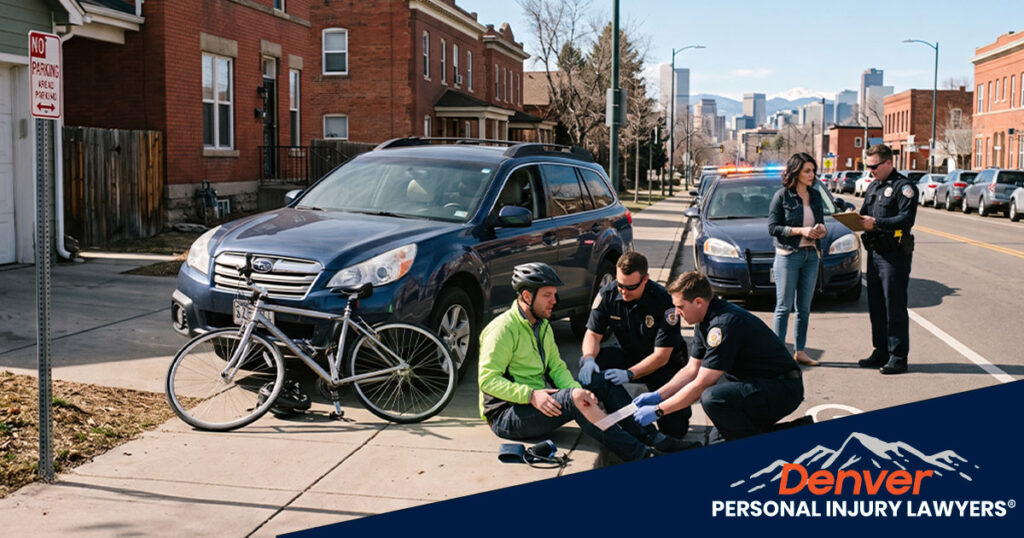
Getting hit by a car while biking on a sidewalk in Denver creates questions about fault and compensation. Colorado generally gives bicyclists and e-bike riders many of the same rights and responsibilities, but local ordinances restrict where bicycles may be ridden. If you were riding somewhere that prohibited bicycle traffic, an insurance company may use that violation to argue that you share responsibility for the crash.
That does not necessarily excuse a negligent driver. Motorists still have duties to watch for cyclists, yield when required, and check sidewalks and crossings before turning or entering traffic. However, because Colorado uses comparative negligence, even a relatively small dispute over where you were riding can affect the amount you ultimately recover.
A Denver bicycle accident attorney can determine which state and local rules applied at the exact location of the crash and evaluate whether the driver, cyclist, or both contributed to the collision.
Table of Contents
ToggleIs Biking on a Sidewalk in Denver Legal?
Colorado bicycle law leaves sidewalk riding up to local rules, which means Denver ordinances determine whether a cyclist was legally riding in a particular location. In Denver, biking on a sidewalk is generally prohibited, although there are limited exceptions.
Cyclists may ride on sidewalks that are part of a designated bicycle route. Denver also allows limited sidewalk riding when a cyclist is within one block of getting on or off the bicycle to park, but the rider must keep their speed at six miles per hour or less.
Because these rules depend on the location and circumstances, it is important to look closely at where the crash happened. A designated bike route, nearby parking area, posted sign, or other traffic-control device may affect whether sidewalk riding was permitted at that specific location.
What Usually Causes a Car to Hit a Cyclist on a Sidewalk
Sidewalk bicycle crashes can happen in several predictable ways. A driver may pull out of a driveway and cross the sidewalk without seeing an approaching cyclist, make a right turn across a crosswalk area, or emerge from an alley with limited visibility.
Poor sightlines can make these situations even more dangerous. Parked cars, garage entrances, buildings, and other obstructions may prevent drivers and cyclists from seeing one another until there is little time to react. Darkness and bad weather can create additional visibility problems.
Driver distraction can also contribute to a crash. Looking at a phone, rushing through an intersection, making a quick turn, or failing to fully check for approaching traffic may leave a driver unaware of a cyclist until it is too late.
Door-related crashes are another risk near parked vehicles. Colorado law requires people to make sure it is reasonably safe before opening a vehicle door into moving traffic. If a door opens directly into a cyclist’s path, that violation may become important evidence when determining responsibility for the crash.
Who Has the Right of Way When You Are Biking on a Sidewalk in Denver?
When sidewalk riding is legally permitted, Colorado law generally gives a person riding a bicycle or e-bike on a sidewalk or through a crosswalk the same rights and duties that apply to a pedestrian. Cyclists must also yield to pedestrians and ride safely around them.
Drivers still have important responsibilities when crossing a sidewalk or entering areas where cyclists and pedestrians may be present. This commonly becomes an issue when a vehicle turns through a crosswalk, exits a driveway, or emerges from an alley across a sidewalk.
However, biking on a sidewalk in Denver can complicate the right-of-way analysis when riding was prohibited at that location. The cyclist’s speed, visibility, traffic signals, signs, and the exact point of impact can all affect how the law applies.
For that reason, right of way is rarely determined by one fact alone. The location of the crash and the actions of both the driver and cyclist must be considered together. A Denver personal injury lawyer with experience handling bicycle accidents can push back when insurers try to place all the blame on the cyclist.
How Fault Works in Colorado and Why Your Compensation Can Drop
Colorado uses comparative negligence. That means both sides can share fault. Therefore, the insurer will try to assign you a percentage.
If you were biking on a sidewalk in Denver in a restricted area, your recovery may be reduced. It may not be automatic zero. Instead, the claim often becomes a negotiation over percentages.
Here are common facts that can increase driver fault, even when sidewalk issues exist:
- Rolling through a stop and blocking the crossing area
- Texting, speeding, or looking in the wrong direction
- Turning across a cyclist’s path without checking the sidewalk
- Rushing through a corner near a bike lane or lane transition
So, even if you made a mistake, the driver can still be mostly at fault.
When a Driver Can Still Be Mostly at Fault
Drivers still have a duty to use reasonable care, so they may carry most of the blame when their actions create the danger.
For example, a driver who pulls across a sidewalk from a driveway or alley without checking for approaching traffic may be responsible for the collision. Rolling forward and blocking the sidewalk can also create a hazard, while evidence of texting or other distraction may support a finding that the driver failed to use reasonable care.
The driver’s actions before the impact can matter as well. Unsafe passing, drifting toward a cyclist, crowding the rider, or making a sudden turn can all become important evidence when determining liability.
In short, a dispute over sidewalk riding does not automatically decide the case. Instead, it becomes one part of the broader fault analysis.
What to Do Right After a Denver Sidewalk Bike Crash
What you do in the first hour can protect your health and your claim. So, take these steps.
- Get to safety, if you can: Move out of traffic and check for injuries.
- Call 911: Ask for medical help if you feel pain, dizziness, or other symptoms. Even if you initially feel okay, some injuries may appear later.
- Ask for a Denver Police response: This can be especially important when someone is injured or the driver may leave the scene.
- Photograph the scene: Capture curb cuts, driveway angles, signs, lane markings, skid marks, vehicle damage, your bicycle, and any visible injuries.
- Get witness information: Collect names and phone numbers before people leave and memories fade.
- Preserve your bike and gear: Do not repair or throw away your bicycle, helmet, clothing, or damaged equipment because they may become important evidence.
- Get the report number: Use it to request the police report once it becomes available.
- Talk to a Denver bicycle accident lawyer: An attorney can review the sidewalk rules, preserve evidence, deal with the insurance company, and evaluate how fault may affect your claim.
Also, be careful with early statements to the insurance company. If you were biking on a sidewalk in Denver, the adjuster may focus heavily on where you were riding and whether local rules allowed it. Before giving a detailed statement, make sure you understand the facts of the crash and the rules that applied at that location.
What You Can Recover in Compensation
A sidewalk crash can create real losses. Therefore, a claim often includes several damage categories:
- Medical bills, including future care
- Lost income and reduced earning ability
- Pain and suffering
- Bike repair or replacement
- Out-of-pocket costs, like rides, prescriptions, and mobility devices
However, insurers often look for ways to reduce what they pay. They may focus on biking on a Denver sidewalk, your speed, your visibility, or whether you should have yielded at a driveway. They may also argue that you should have been riding in the street.
Serious driver negligence can still strengthen your claim, even if you share some fault. Texting, speeding, an unsafe turn, or a clear failure to yield can all weigh heavily in the liability analysis.
Timing matters as well because early recorded statements can affect how the insurer evaluates the case. Avoid guessing or speculating about what happened, and stick to the facts you know. A Denver personal injury lawyer can review the evidence, protect you from unfair fault arguments, and help present the strongest possible version of your claim.
FAQs (Frequently Asked Questions)
Is Biking on the Sidewalk Legal in Denver?
Biking on a sidewalk in Denver is generally prohibited, with limited exceptions. Riders may use designated bicycle routes and may ride near parking areas under specific conditions.
Who Has the Right of Way When Biking on a Sidewalk in Denver?
When sidewalk riding is legal, cyclists generally have the rights and duties of pedestrians. Drivers must still watch for cyclists and yield when required at crossings, turns, and other conflict points.
What Causes Sidewalk Bicycle Accidents in Denver?
Common scenarios include drivers crossing sidewalks from driveways or alleys and turning through crosswalks without seeing a cyclist. Poor visibility, distraction, and obstructed sightlines can also contribute to a crash.
How Does Fault Work in Colorado Sidewalk Bicycle Accidents?
Colorado uses modified comparative negligence, so both the cyclist and driver can share fault. Your compensation decreases by your percentage of fault, and recovery can be barred if you are equally or more at fault than the defendant.
Can a Driver Be Mostly at Fault If I Was Biking on the Sidewalk Illegally?
Yes. A sidewalk violation does not automatically make the cyclist responsible for the crash. A driver may still carry most of the fault for an unsafe turn, distraction, failure to look, or another negligent action.
Sidewalk Rules Could Affect Your Denver Bicycle Accident Claim
If a car hits you while biking on a sidewalk in Denver, several details can affect your claim. The crash location matters, as do local sidewalk rules and the actions of both parties. Insurers may also use comparative negligence arguments to reduce what they pay.
At Denver Personal Injury Lawyers®, we can investigate the crash and review the rules that applied. We can also gather police reports, medical records, photos, witness statements, and other evidence. Our attorneys can handle insurance communications and calculate both current and future damages.
Insurers may try to make a sidewalk violation the focus of the entire case. That can happen even when the driver played a major role in causing the crash. Contact us for a free consultation to review the evidence and challenge unfair fault arguments. We can also help protect the full value of your bicycle accident claim.
